“We bought the fastest press on the market. Now it sits idle half the time because it can't handle our short runs.”
That is not a rare complaint. According to a 2024 operational survey by Converting Magazine, nearly 42% of packaging printers say their gravure equipment underperforms for at least one key job type. The culprit? Not the machine itself – but the selection criteria used to buy it.
Whether you print flexible packaging, transfer paper, or decorative foils, the difference between a profitable press and an expensive bottleneck comes down to six tips that most brochures won't tell you. Let's cut through the marketing claims.
Every supplier advertises a dazzling top speed: 400 m/min, 500 m/min, even 600 m/min. Here is the truth: no one runs at max speed for more than 15% of the time – not in flexible packaging, not in label printing.
Why? Because real-world conditions kill top speed:
Substrate splices cause tension spikes
Ink viscosity changes with temperature
Drying capacity lags during humid summer months
What matters is sustained operating speed – the speed you can run for eight hours without operator intervention. Ask suppliers for test data at 80% of the claimed max speed over four continuous hours. One European converter told me: “Our 500 m/min press effectively runs at 310 m/min. The dryer simply can't keep up with solvent inks beyond that.”
Pro tip: Look for machines with independent drying zone controls. Being able to shut off unused zones saves energy and prevents over-drying on thin films.
Total Indicated Runout (TIR) is the single most ignored spec. And it is the #1 cause of ghosting and banding.
ISO 14616:2004 specifies acceptable runout for gravure cylinders under load: ≤0.03 mm for high-quality packaging work. But many manufacturers test at the factory floor with no web tension. That is like measuring tire balance on a lifted car.
What you need:
Dynamic TIR measured at operating temperature (after 30 minutes of running)
Under-web-tension report (typically 15–25 N/cm width)
Cylinder-to-cylinder variation – the worst cylinder defines your quality
A senior technician from a Thai flexible packaging plant shared this: “We rejected three cylinders from a reputed supplier because static TIR was 0.02 mm, but dynamic TIR jumped to 0.09 mm. They never ran clean.”
At this point, you might wonder: “How do different press manufacturers document dynamic TIR?”
Compare real-world TIR reports and mechanical tolerance data from Fangbang
It is easy to show perfect register on 50 µm PET. The real test is 20 µm metallized film or low-stiffness stretch wrap.
Three registration killers that show up after purchase:
Thermal expansion mismatch – aluminum cylinders expand faster than steel impression rollers, causing color drift after the first 20 minutes
Low-tension flutter – web tension below 8 N/cm makes register sensors lose tracking
Gear backlash – in non-shaftless presses, wear in mechanical gears creates cumulative error
Ask for a trial using your own substrate at three tension levels: low (8 N/cm), medium (15 N/cm), and high (22 N/cm). Measure the register every 15 minutes for 90 minutes. A modern shaftless drive system with individual servo motors will stay within ±0.1 mm without manual correction.
One American label converter learned this lesson after purchase: “Our press was great on 40 micron OPP. But on 18 micron metalized, we had 0.4 mm drift every 45 minutes. The supplier's 'universal spec' meant nothing.”
This is where most buyers leave serious money on the table.
Energy costs for gravure drying typically represent 30–45% of total operating expenses after the first year. Yet selection sheets only show “installed dryer power (kW)” – a useless number by itself.
Better metric: kWh per kilogram of solvent evaporated
| Drying Technology | kWh/kg solvent | Typical payback period |
|---|---|---|
| Standard electric + exhaust | 1.8 – 2.4 | – |
| Recirculation (70% air reuse) | 1.2 – 1.6 | 6–12 months |
| Recirculation + heat recovery | 0.8 – 1.1 | 12–18 months |
| Catalytic oxidizer integration | 0.6 – 0.9 | 18–24 months |
According to Energy Efficiency in Converting (Fraunhofer Institute, 2023), switching from standard exhaust to a 70% recirculation system on a 10-color press saves approximately 78,000 kWh annually – equivalent to $11,700 at $0.15/kWh.
Ask the supplier: “What is your dryer's air recirculation ratio at 70% fan speed?” If they cannot answer, walk away.
Every brochure shows a smooth 12-minute cylinder change with three smiling technicians. Real life is different.
Hidden time-wasters:
Bolt-on doctor blade assemblies requiring 18 screws (instead of 4 cam locks)
Cylinder adapters that need shimming for each repeat length
Impression roller cleaning that demands removing the roller entirely
A better approach: Ask for a changeover video (unedited) of the same operator changing from Job A to Job B, including cleaning. Count the minutes. Industry benchmark for a 6-color press:
≤15 minutes – excellent (cantilevered shafts + quick-lock adapters)
15–25 minutes – acceptable
30 minutes – will kill your short-run profitability
One Indian packaging plant reported: “Our old press took 48 minutes per changeover. With a modular design, we are down to 16 minutes. That gives us two extra jobs per shift.”
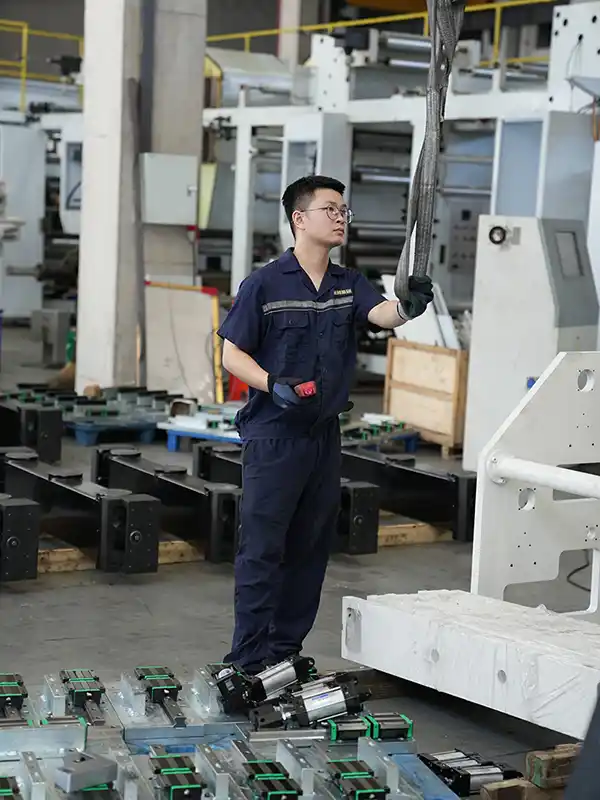
Want to see how quick-change components are actually implemented on a production floor?
View Fangbang’s modular station design and changeover demonstration
The press price is only the beginning. By year three, consumables often exceed the original machine cost.
| Consumable | Typical annual cost (8h/day, 5 days/week) | What affects it |
|---|---|---|
| Doctor blades | $3,000 – $8,000 | Chamber design, substrate abrasiveness |
| Cylinder storage & handling | $2,500 – $12,000 | Number of repeats, automation level |
| Bearings & seals | $1,800 – $5,500 | Sealed vs. greased bearings |
| Ink pump seals | $800 – $2,500 | Solvent compatibility |
Get the supplier to sign a consumables consumption table based on your runtime. One European converter told me: “The supplier who gave us a detailed five-year forecast turned out to be the most accurate. The one who refused? We stopped talking.”
Also, ask about commonality – do different models share bearings, seals, and doctor blade holders? If not, you will stock twice the spare parts.
You now have six concrete filters: sustained speed → dynamic TIR → substrate-specific registration → drying energy per kg solvent → real changeover time → five-year consumables forecast.
Take this checklist to your next supplier meeting. Ask for test reports, not promises. Request unedited changeover videos. Demand energy calculations in kWh/kg, not kW.
When you are ready to see how these six tips translate into actual machine specifications – with documented dynamic TIR reports, energy recovery data, and modular quick-change components – you can explore one manufacturer's detailed technical library.
Request a customized six-point evaluation sheet for your substrate types
The best gravure press is not the one with the highest number on the brochure. It is the one that runs reliably on your films, with your operators, at your energy rates. Select accordingly.
*References: ISO 14616:2004 – Plastics – Heated air drying systems; Fraunhofer Institute (2023) Energy Efficiency in Converting; Converting Magazine 2024 Operational Survey (n=312 packaging converters); anonymized plant interviews from Thailand, India, and Europe.*
Apr 20, 2026
Gravure Printing Machine Selection: 6 Must-Know TipsApr 17, 2026
What to Look for in a High-Speed Computerized Color Register Rotogravure PressApr 15, 2026
2026 Gravure Printing Machine Selection Trends