Choosing a gravure printing machine feels overwhelming. You walk into a trade show or browse online, and every supplier promises “high speed,” “perfect registration,” and “low maintenance.” Yet, according to a 2023 survey by Printing Industries of America, nearly 35% of packaging converters admit that their first gravure press did not meet the expected return on investment – mainly due to mismatched specifications.
How do you avoid becoming part of that statistic? Whether you print flexible packaging, labels, or decorative laminates, the decision comes down to four practical steps. No hype, no jargon traps. Just what matters for your production floor.
Most buyers start with “I need a fast press.” That is too vague. Start instead with three concrete numbers:
Average monthly print length (in linear meters or feet)
Maximum substrate width – do you run 800 mm, 1200 mm, or wider?
Typical ink coverage and drying demands – solvent-based, water-based, or hybrid?
Here is an industry truth: over-speccing a press by 30% in speed increases capital cost by roughly 50%, while under-speccing the drying capacity leads to smearing and ghosting – even if the mechanical speed is high. One flexible packaging plant in the Midwest learned this the hard way: they bought a 400 m/min press but only ran it at 180 m/min because the dryer could not handle their solvent-rich inks.
So before you compare brands, write down your worst-case substrate (thickest gauge, stickiest ink) and your peak-season weekly runtime. That baseline will filter 70% of unsuitable models.
A gravure press is a symphony of rotating mass. The three mechanical components that cause 80% of unplanned downtime are:
Cylinder (drum) runout – anything above 0.03 mm total indicated runout (TIR) under load will create banding. ISO 14616:2004 gives a clear reference for acceptable runout in flexible packaging printing.
Doctor blade chamber design – closed-chamber systems reduce solvent evaporation by 20–25% compared to open fountain types, according to data from Flexo & Gravure International.
Bearings on the impression roller – sealed, lifetime-lubricated bearings are not a luxury; they are a maintenance saver on 24/7 lines.
If a supplier hesitates to share their TIR test report or bearing manufacturer (SKF, FAG, or equivalent), that is a red flag. You want modular construction that allows you to replace a doctor blade assembly without dismantling half the station.
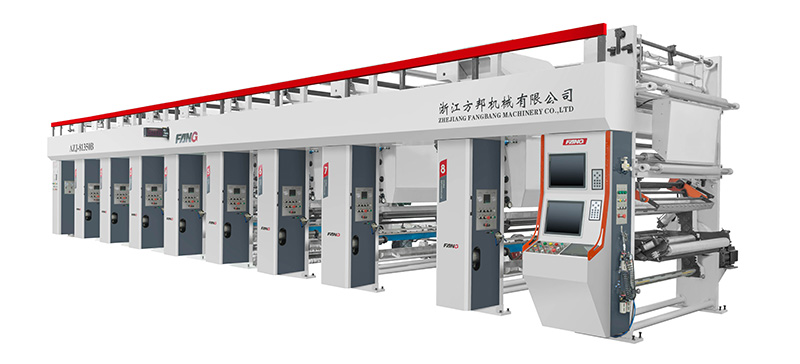
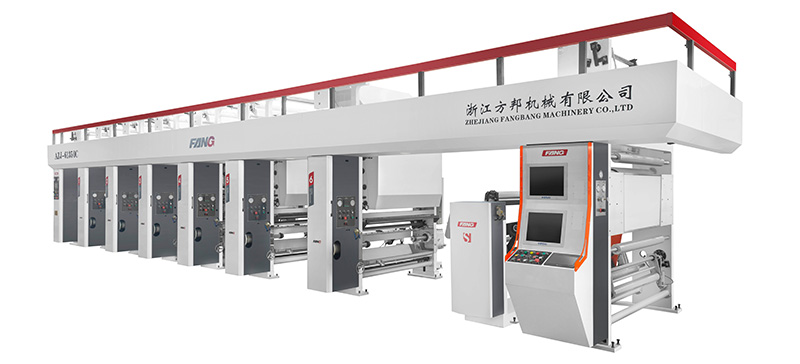
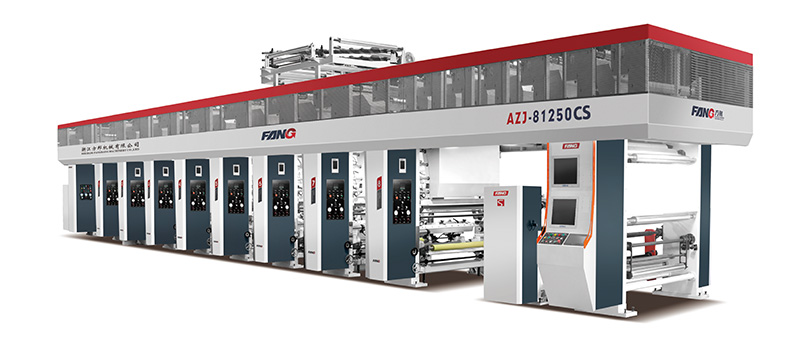
At this stage, many engineers ask: “What does a truly modular station look like?” Check modular design examples and technical drawings from Fangbang – you can see how segmented frames simplify maintenance.
A press can show 0.1 mm registration error at idle, but under full web tension and temperature, that error often triples. This is where automatic register control systems separate entry-level from production-grade machines.
Look for three specific features:
Shaftless independent drive technology – each printing unit has its own servo motor. This eliminates cumulative mechanical backlash.
Real-time web tension feedback loops – sensors placed before and after each station, with response time under 50 ms.
Warm-up compensation – some presses automatically adjust for thermal expansion of cylinders after the first 30 minutes of running. Without this, your first few hundred meters become waste.
A practical test: Ask for a trial run on low-tensile film (e.g., 20 µm PET) with a repeat length of 600 mm. At 200 m/min, measure color-to-color register every 15 minutes for two hours. A well-designed system will stay within ±0.15 mm without operator tweaking.
For production managers who want to reduce make-ready waste by 40–60%, the automation level of the register control is the single biggest lever.See how Fangbang’s servo-driven register system performs on thin films – real shop-floor data available.
A gravure press consumes more energy than any other converting machine in most plants – except the extruder. But many buyers only look at kW ratings, not operational duty cycles.
Break it down:
| Cost Factor | Typical Range (per press, 8 h shift) | What to check |
|---|---|---|
| Drying energy (electric or gas) | 150–400 kWh | Recirculation ratio (≥70% is good) |
| Solvent emissions abatement | $12–35 per shift | Integrated thermal oxidizer or catalytic converter |
| Cylinder storage & handling | 5–10% of press cost annually | Quick-change adapters, cantilevered design |
| Blade & ink consumption | 0.8–2.2 € per 1000 m² | Closed chamber vs. open blade |
Some presses now feature heat recovery tunnels that reuse exhaust air to pre-heat incoming web – cutting gas usage by up to 30%. Others offer quick-release cylinder sleeves that reduce changeover time from 45 minutes to under 12 minutes. That difference alone can add two extra jobs per day on a two-shift schedule.
A senior maintenance manager from a European décor printing company once told me: “We saved $47,000 in the first year just by switching to a press with independent drying zone controls. The previous model heated all zones even when only two were running.”
If your plant runs more than 5000 hours per year, a 10% difference in drying efficiency equals roughly $15,000–20,000 annually. That is real money.
Even with the four steps, buyers fall into two classic traps:
Chasing maximum speed – A 500 m/min press that cannot maintain tension below 300 m/min is useless for short runs or delicate substrates.
Ignoring local serviceability – Does the supplier have spare parts in your continent? What is the guaranteed response time for a broken driver board? One Asian converter waited 11 weeks for a proprietary servo drive.
You now have a framework: define parameters → inspect mechanics → verify registration → calculate energy cost. Bring this checklist to any supplier presentation. Ask for written test reports under your own substrate conditions.
When you are ready to see how these four steps translate into a specific machine configuration – with clear modular options, energy recovery data, and register test results – you can explore one manufacturer’s detailed offering.
Request a customized selection sheet based on your film width and ink type
The right gravure press does not just print faster; it prints smarter, wastes less, and keeps your line running through weekends. Start with your substrate list, not the brochure. That is how industry veterans choose – and you can too.
References: ISO 14616:2004 – Plastics – Heated air drying systems; Printing Industries of America 2023 CapEx Survey; internal maintenance logs from packaging plants (anonymized).
May 28, 2026
Gravure Printing Machine Selection – Don’t Ignore After-SalesMay 25, 2026
Gravure Printing Machine Selection: How Registration WorksMay 22, 2026
Flexible Packaging? Gravure Printing Machine Selection Tips